.jpg)
Walking into Florence feels like opening a thick, richly illustrated book of the Renaissance. Sunlight drapes the terracotta rooftops in gold, a gentle breeze drifts in from the Arno River, and the reflection of history ripples beneath the stone bridges. I had imagined this city countless times—through books, paintings, films, and music—but stepping into the Uffizi Gallery is when I truly understood the meaning of “time travel.”
It was a journey of the heart—a deeply immersive blend of art and history. In that silent yet profoundly soulful museum, I felt like a traveler navigating different epochs, walking side by side with Botticelli, da Vinci, Raphael, and Michelangelo, experiencing their passion, their struggles, and their quest for eternity.
1. Entering the Uffizi: The First Glimpse of an Artistic Sanctuary
The Uffizi Gallery is located in the heart of Florence, next to Palazzo Vecchio and the Arno River. Built in the 16th century as offices for the Medici family, it is now one of the world’s top four art galleries. That morning, I set out from the Florence Cathedral, strolling along the stone-paved streets, passing Palazzo Pitti and Ponte Vecchio, with a mood as bright as early spring sunshine.
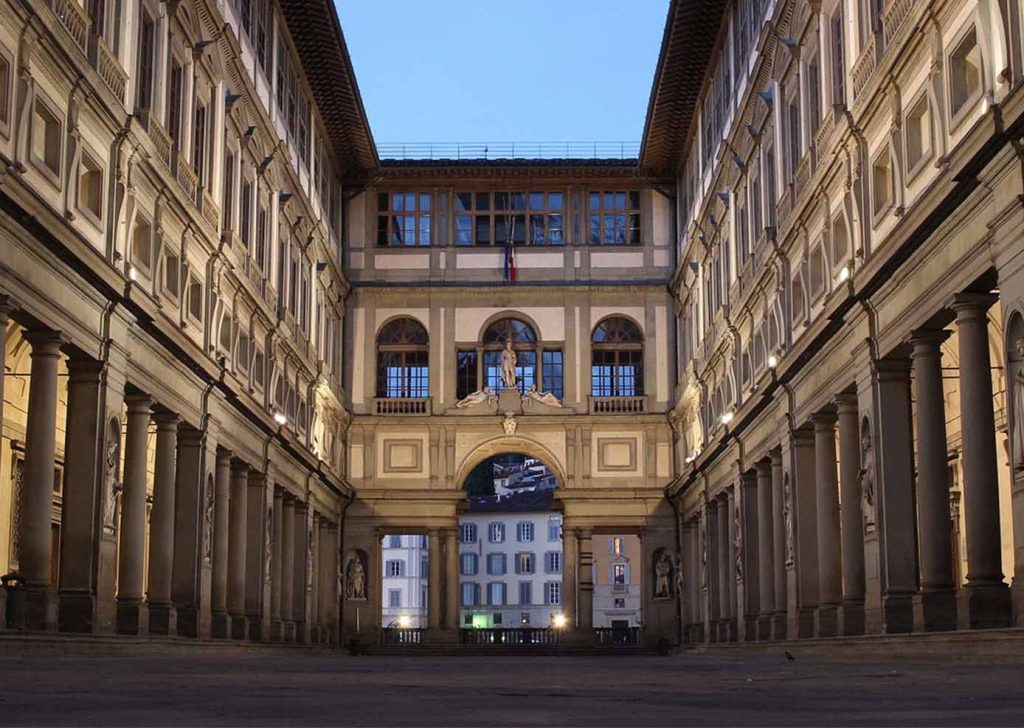
Standing beneath the Uffizi’s classical colonnades, framed by tall windows, I finally grasped what “the weight of history” truly means. Inside, modern security checks and electronic ticket systems operate with efficiency, yet they do nothing to diminish the solemn grandeur the architecture exudes. At that moment, I felt a slight tension—as though I was about to meet several old friends, separated by centuries, yet waiting for me to arrive.
2. Botticelli Gallery: The Pinnacle of Beauty, A Pause in Time
The first stop was the Botticelli Gallery at the end of the second-floor corridor. Almost everyone visiting Uffizi has a single chief aim: Botticelli’s two iconic works, Primavera and The Birth of Venus.
Standing before The Birth of Venus, I was genuinely awestruck. The goddess rises from the sea on a shell, her hair flowing, her gaze tender, surrounded by spring breezes and blossoms. It’s not just a painting—it’s a poem of love and beauty.
I spent a full ten minutes frozen in place, studying the expressions of the figures, the texture of their clothing, the direction of the flowing water, and the layers of color. Even the most delicate brushstrokes revealed the devotional intensity of the artist’s soul.
In front of Primavera, the interaction among the nine deities, the goddess of flowers, and Cupid enthralls you. Each figure carries symbolic meaning; every flower is laden with allegory. The canvas is a treasure chest of meaning, ripe for gradual revelation.
3. Leonardo da Vinci & Michelangelo: Glimpsing Divinity Through Humanity
Leaving the Botticelli Gallery, I moved into the rooms showcasing da Vinci’s early works. For the first time, I saw Annunciation up close. The Archangel Gabriel bows gently, the Virgin Mary’s expression is serene—the scene exudes a divine stillness.
I couldn’t help but wonder if da Vinci realized this work was redefining Western painting in spatial composition and chiaroscuro. The subtle transitions, the delicacy of the hands, and the distant hills fading into the light—all were mesmerizing.
Nearby, Michelangelo’s Doni Tondo dazzled me with its robust contours, exaggerated anatomy, and extraordinary three-dimensionality. His figures seem to leap from the canvas, interacting with viewers in a primal, visceral way. That force transcends mere brushwork—it speaks directly to the soul.
-1024x728.jpg)
4. Raphael & Titian: Two Extremes—Grace and Passion
Raphael’s La Fornarina and Portrait of Pope Julius II deliver a sublime harmony and gentle elegance. His colors are crystal-clear, his figures tender and human; standing close, it feels as if those eyes are peering into your innermost being.
In contrast, Titian’s works embody intense passion. He layers colors to express emotion, using brushstrokes to convey feeling. Whether it’s Venus of Urbino or numerous mythological scenes, the paintings are charged with sensual energy.
Wandering between these two galleries is like oscillating between tenderness and fervor—two extremes of artistic expression mirroring each other.
5. Corridors and Windows: A Dual Feast of Architecture and Panorama
The Uffizi is not just an art gallery—it is itself a masterpiece. The long corridors on the second floor resemble artistic passageways; the floors are paved with geometric-patterned stone, portrait paintings hang on the walls, and the ceilings feature 17th-century frescoes.
Peering out from the corridor windows, the Arno River flows lazily beneath Ponte Vecchio, amid pedestrians and merchants. Florence’s red rooftops and slender bell towers stretch into the distance. I inhaled deeply, feeling as if every molecule carried an echo of art itself.
This “walking while viewing” experience transforms a static exhibition into a living, immersive time machine. You become not just a tourist, but a witness—perhaps even a participant.
6. Hidden Histories: Politics, Religion, and Lives Within Art
The greatness of the Uffizi lies not only in its collection’s volume but also in the stories behind the works. From Medici patronage to the artists’ faith and political stances, to the symbols encoded within the paintings—each canvas is a cipher of history.
In one gallery, looking at Brunelleschi’s Baptism of Christ, I noticed the barely visible angel wings beneath Jesus’ feet and realized: the artist wasn’t just painting—he was communicating with future viewers.
You can’t access these layers of meaning through online images or art books. Only standing before the actual work, you can feel its scale, its palette, its atmosphere—you truly “enter” its world.
7. Immersive Audio Guides: When Technology Meets Art
To enhance my understanding and fully immerse myself in the experience, I rented the Uffizi’s official audio guide—a sleek, easy-to-use device that became my silent companion throughout the gallery. At each gallery stop, I simply entered a number corresponding to the artwork, and an expert voice delivered insightful commentary on the historical context, creative techniques, and symbolic layers embedded in each masterpiece.
The narration was soft and well-paced, sometimes accompanied by ambient music that subtly matched the era or emotion of the work. Stories about the artists’ lives, Medici family dramas, and little-known anecdotes brought the art to life, like a private tutor whispering secrets of the Renaissance in my ear. It felt as if I had stepped inside the minds of the creators themselves.
I realized that the guide did more than provide information—it awakened my imagination. Rather than being a passive observer, I became an active participant, uncovering connections and meanings I might have otherwise missed. It transformed the visit into a truly layered, intellectually engaging journey.
8. Gift Shop and the Final Glance: Taking Art Home
At the museum’s exit, I found myself drawn into the well-curated gift shop—a bright, inviting space brimming with creativity and charm. It wasn’t just a souvenir stop; it felt like an extension of the gallery itself. The shelves overflowed with art-themed treasures: beautifully bound books, vibrant postcards, silk scarves, puzzles inspired by famous paintings, notebooks, and handmade jewelry.
I lingered among the items, reluctant to leave the world I’d just immersed myself in. Eventually, I chose a richly illustrated Uffizi catalogue, which would allow me to revisit the masterpieces at my own pace, and a silk scarf adorned with The Birth of Venus, as a tangible memory of the emotion that painting had stirred in me.
As I stepped out into the Florentine sunlight after more than four hours, I turned back to take one last look at the grand façade. I felt a deep sense of gratitude—and a hint of wistfulness. This hadn’t been just a museum visit. It had been a journey across centuries, a dialogue with genius, a moment of quiet awe that would stay with me forever.
9. Practical Tips: Navigating the Uffizi with Elegance
To help others enjoy this phenomenal journey, here are some practical suggestions:
- Book in advance: During peak season, reserve tickets at least a week ahead via the official website (www.uffizi.it) or platforms like Firenze Musei or GetYourGuide to bypass long lines.
- Avoid crowds: Visit during the first hour after opening or after 14:00, when foot traffic is lighter, allowing for quieter appreciation.
- Allow enough time: Plan for at least three to four hours; if you want a thorough audio-guided experience, allow five hours or more.
- Dress comfortably: Wear comfortable shoes—you’ll walk extensively on stone floors.
- Focus on art, not cameras: Though photography is allowed in most areas, concentrating on the art—rather than on taking pictures—enhances your experience.
- Download audio content early: Some galleries have spotty signal, so download audio guide content beforehand.
10. My Connection with the Uffizi: An Everlasting Memory
Travel’s magic isn’t just seeing new places—it’s discovering new parts of yourself. For me, the Uffizi was a baptism of ideas and spirit.
I watched Venus emerge from the sea, felt the calm of the Annunciation, read the sorrow in the Pope’s eyes, and imagined a pastoral world through painted scenes.
This was not just Florence’s story—it was humankind’s story. In that ancient city, inside that gallery filled with light and shadow, I truly traveled through time.
May everyone who visits Florence step into the Uffizi, linger before a painting, and take with them their own artistic memory. It may be the most precious travel souvenir of their lifetime.